
The Mathematics of Beauty: Crafting a Portrait with Timeless Principles
What makes a work of art beautiful? Is it a matter of subjective taste, an indefinable “I know it when I see it” feeling? Or is there something more? For centuries, the world’s greatest masters understood a profound secret: true, lasting beauty is not an accident. It is a science. It is built upon a foundation of timeless mathematical principles.
At KGS Studios, we do not leave beauty to chance. We engineer it. This is the philosophy behind the Mathematics of Beauty, an objective, deliberate approach to composition that ensures your portrait is not just a fleeting image, but a masterpiece of harmony and design.
The Unseen Architecture: From the Golden Ratio to Dynamic Symmetry
Since the time of the ancient Greeks, artists and architects have known that the universe is filled with elegant mathematical patterns. The most famous of these is the Golden Ratio (1:1.618), a proportion found everywhere from the spiral of a seashell to the structure of the human face. It is a code for organic, natural beauty.
When I compose a portrait, I use this divine proportion as my guide. The placement of an eye, the curve of a shoulder, the flow of fabric; these are not arbitrary decisions. They are carefully mapped to align with these principles, creating a composition that the human eye instinctively recognizes as balanced, harmonious, and beautiful.
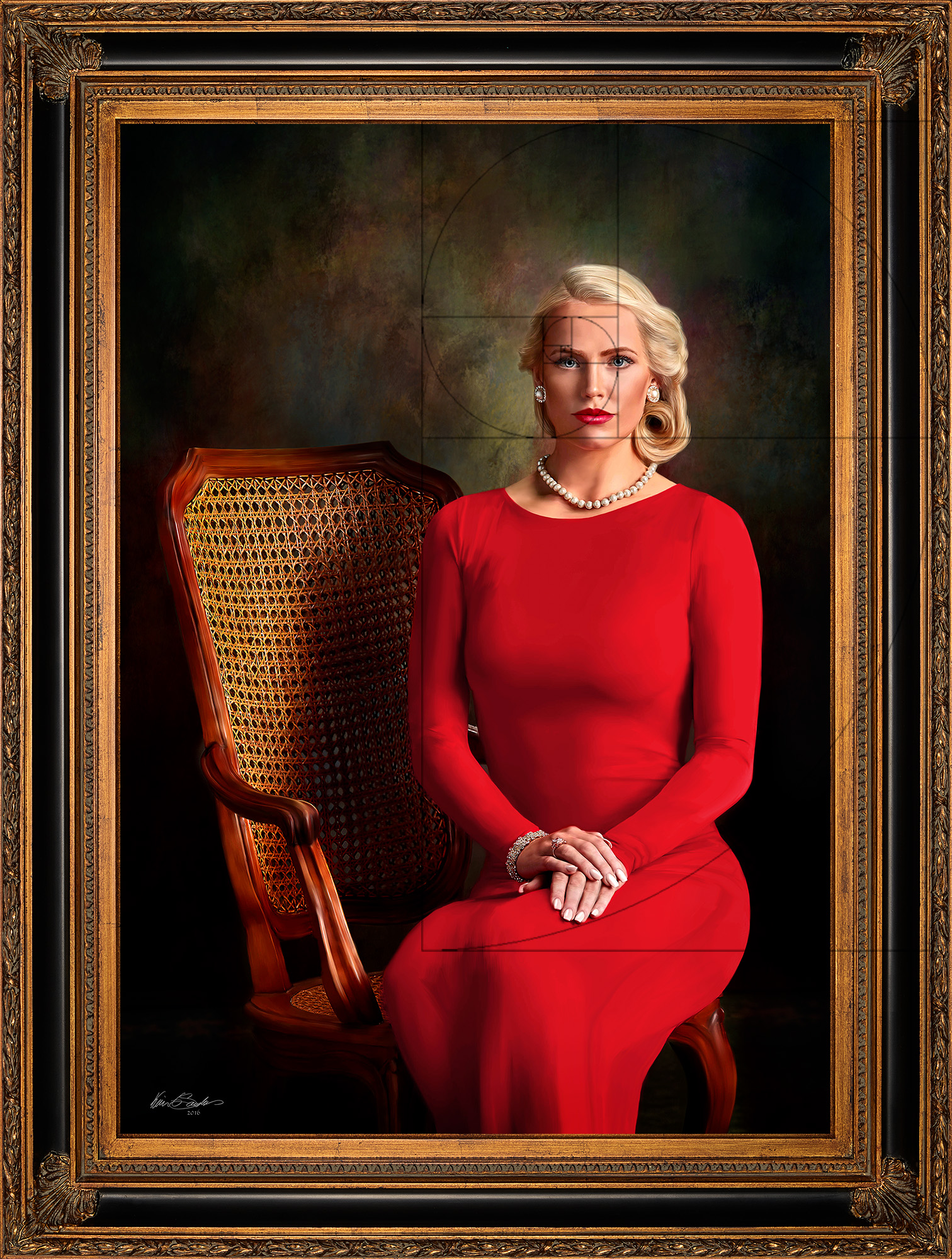
Beyond the Golden Ratio, I employ more advanced classical techniques, such as Dynamic Symmetry. This system of grids and diagonals, rediscovered in the early 20th century, was the secret used by masters to imbue their static canvases with a sense of life, rhythm, and graceful movement. It is the unseen architecture that directs the viewer’s eye through the portrait, creating a visual journey that is both engaging and deeply satisfying.

From Principle to Intuition
For any master artist, these principles are not a rigid checklist applied after the fact. Through years of dedicated practice, they have become an intrinsic part of my artistic vision, an intuitive sense of balance, rhythm, and harmony. My 2016 portrait of Emma, for example, was composed not with a calculator, but with an innate understanding of classical form. The mathematics serves to confirm what my artist’s eye already knows. It is entirely intuitive, and I consider it a divine gift of compositional awareness.
This is the promise of our process at KGS Studios: to deliver a portrait whose harmony is not just felt, but is structurally engineered and intuitively crafted, ensuring a standard of excellence that transcends trends and stands the test of time.
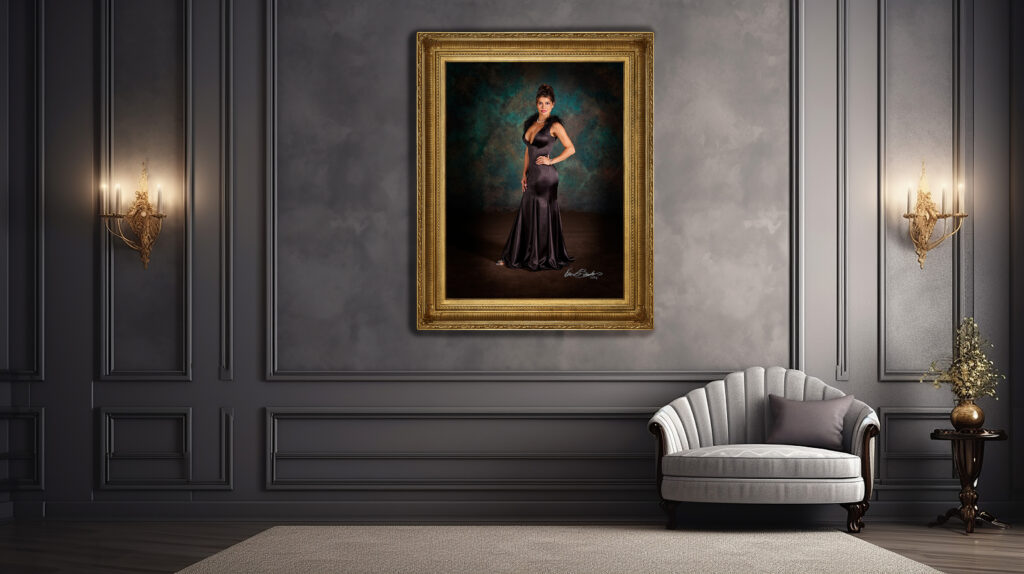
To see how these principles are applied in our collaborative journey, I invite you to explore The Co-Creation Process.